

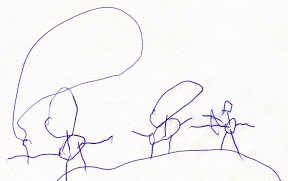
Recently I went to the doctor for my son’s yearly check-up. Our doctor is fantastic, and I am so lucky that I was fortunate enough to get him. Everytime we go, I learn something very interesting, this time was no exception.
The Doctor started asking standard medical questions: Was Jakub seriously ill this past year? Any ear infections? etc. Then he turned to his mental, social and physical development. And he asked me:
“Does Jakub know how to draw a person?”
I answered that probably yes, because he draws dinosaurs all the time, but I can’t remember any people he drew recently… So the doctor gives Jakub (my 4 year old son) a piece of paper and asks him: “Draw a person”. After a bit of shock and shyness, Jakub complies and draws a person. He started with a head, then a body, arms, legs, some eyes and mouth on the head – in their proper positions, and then also some hair. Nothing artistically pleasing, but just a stick figure (unfortunately I couldn’t take the picture with me, as the doctor wanted to keep it in his records – the picture above is also Jakub’s picture, from February 2008 – he was 3 years and 10 months old). The doctor said that was interesting, and started explaining the theory behind the “draw a person” test to me.
He said that at the test is very universal. Many studies show that the results are similar in all the corners of the earth. The way the kids draw the person determines at what mental developmental stage they are at. You can pretty much test for intelligence with a simple drawing. At the age of 3 kids start to draw circles and lines, but usually can’t really make a stick figure look like a person. At the age of 4, they are supposed to start drawing people more like we’re used to: head, arms, legs. But at the age of 4 (mental age of 4) most kids draw the arms and legs coming out of their heads – no body. Jakub didn’t do this. His picture had a body. Even in the picture above – drawn when he was 4 months shy of four, Jakub drew a body. The doctor said that this was an indication that his mental development stage is more like a 5 year old rather than a 4 year old (I always knew my son was smart :)). At the age of 5, children start drawing bodies, arms and legs coming from the bodies. Then, between 5 and 5.5, kids start to draw more detail, including 3 fingers (not 5), clothes, etc. The doctor didn’t go into more than this – figuring I’m not interested past my son’s age anyway.
But when I got home, I wanted to know more about this cool non-invasive test: the Draw a Person test. I actually didn’t know it was called that until I researched it online. Supposedly this test has been around for a whole century, and it’s been used everywhere in the world, for children of many ages (up to 13 as I’ve seen in the few studies I read through), and by psychologists to analyze not only intelligence but also emotional stability of kids. It is the perfect test, because it is very simple and non-invasive, yet so telling of the child.
As I understand it, the procedure to administer the test is to tell the child: “Draw a Person” with not much more explanation. After that, there is a series of points the psychologist can award, depending on the picture’s details (is there a neck? clothing? proportions correct? size of picture? etc.). Then, based on the child’s age and the points of the picture, a mental age equivalence can be given. Cool!
A few days after my appointement, after picking up Jakub from Pre-School, I found a picture of two stick figures in his school bag. The hands and legs were coming out of the head. I was shocked… Jakub drew this? Did he regress in just a few days? I asked him: “Did you draw this?” He said: “No, Emily drew this picture for me.” He was so proud that his friend drew a picture for him, and I was happy to see that the DAP test is for real.
If you want to see some real studies (not on my child but on a statistical level) on this DAP test, here are some good sites I found:
- Generational gains on the Draw-a-Person IQ scores: A three-decade comparison from Turkey
- Validity of the Draw a Person: A Quantitative Scoring System with the WISC-R
Here are some excerpt from a couple books I found on this topic:
- Using Drawings in Assessment and Therapy: A Guide for Mental Health Professionals
- Tools of the Trade: A Therapist’s Guide to Art Therapy Assessments
If you’re interested in this sort of thing, you might want to check out these great resources:
- Using Drawings in Assessment and Therapy
- Interpreting Psychological Test Data
- Using Drawings in Assessment and Therapy: A Guide for Mental Health Professionals
- Measurement of Intelligence by Drawings (Classics in Child Development)
- The Silver Drawing Test and Draw a Story: Assessing Depression, Aggression, and Cognitive Skills
Update: I just got a hold of a scoring guide for the DAP test. I used it to score the middle figure in the picture above from my son’s 3 year 10 month drawing. It got a score of 8. This corresponded to a mental age of 5 years old, which can be divided by my son’s chronological age of 3.83 to give him an IQ of 130. Cool!
Update: When my son was in grade six, he got tested at school for IQ. His IQ was 145. So the DAP test was a bit off.